



























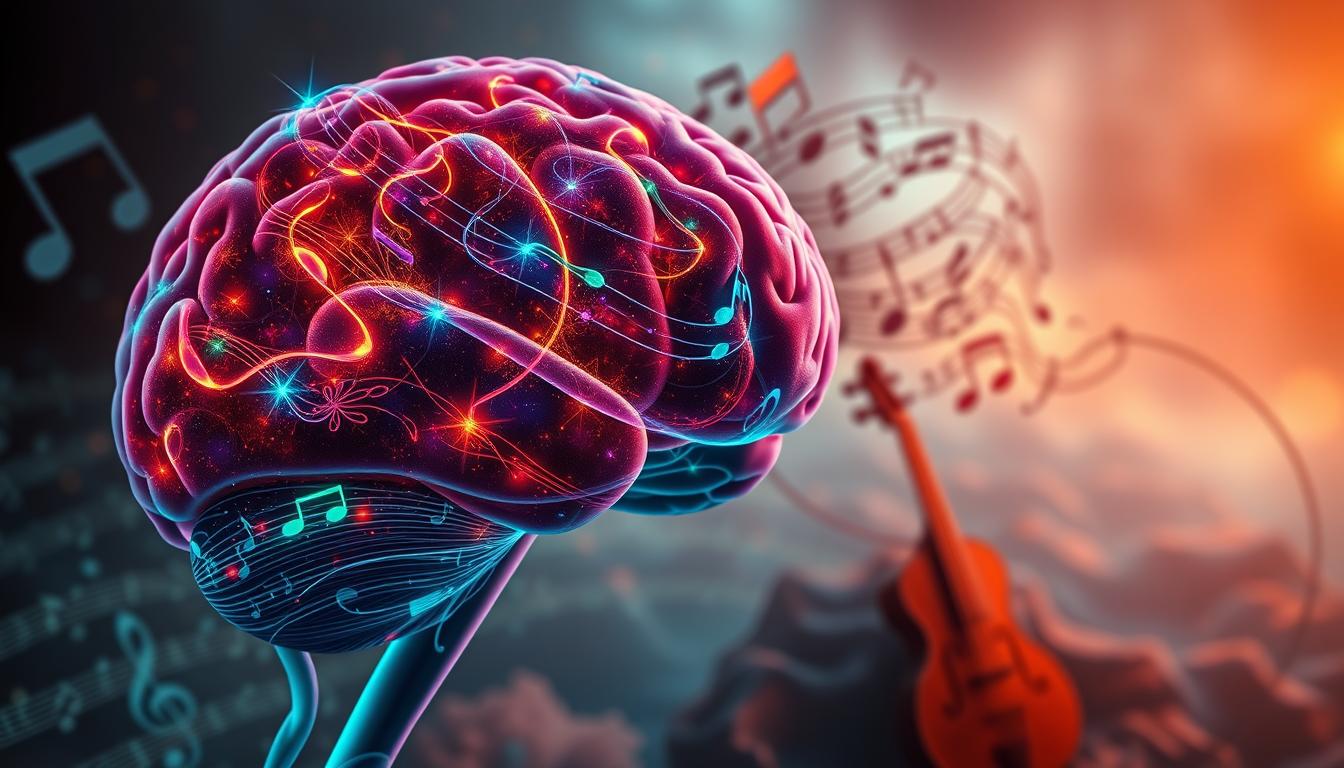
“Life seems to go on without effort when I am filled with music.” – George Eliot. Music is more than just background noise. It shapes how our brains handle emotions and thoughts. When Bradley Cooper leads the London Symphony Orchestra in Ely Cathedral, everyone focuses together. This shows how music turns on the brain’s limbic system, linked to memory and feelings.
Music makes connections in the brain, including the hippocampus, amygdala, and motor areas. This creates a link between sound and emotion. Research shows Mozart’s Sonata for Two Pianos in D Major can even help reduce seizures in people with epilepsy. This proves music’s direct effect on the brain.
Dopamine, released by melodies, improves focus and mood. Singing with others also lowers stress hormones like cortisol. This science is real: it’s why music therapy helps those with Parkinson’s or Alzheimer’s keep memories in the hippocampus.
Music can calm hospital patients or even increase spending in stores. It changes our thinking in both big and personal ways. This article dives into how sound changes our minds, from brain paths to cultural beats.
The Connection Between Music and Emotion
Music has a big impact on our feelings every day. When we hear a song, our brain’s emotional center kicks in. This isn’t just chance: the rhythm, melody, and harmony in music can make us feel happy, sad, or nostalgic.
Sad music, for example, can actually make us feel better. It lets us safely express our emotions, a way of emotional regulation through music.
Science shows that dopamine plays a big part in music’s power. When we hear a song we love, dopamine is released in our brain. This is why hearing a favorite song can instantly make us feel better—a natural music mood enhancement tool.
Even people with brain injuries who can’t name melodies can recognize the emotions in music. This shows how deeply music is connected to our brains.
Musical chills, that amazing feeling, are linked to dopamine spikes in certain brain areas. These moments are not just personal; they’re shared by many. Studies show 55-86% of people experience them, often during unexpected harmonies or crescendos. This dopamine and music connection shows why music is a universal language for emotion.
Music can calm our nerves or bring us joy. It helps us deal with our feelings. Therapists use it to help Alzheimer’s patients remember, and hospitals use playlists to reduce pain. From concerts to playlists, music’s emotional power helps us through life’s ups and downs.
Music as a Tool for Memory Enhancement
Music and memory are closely linked. Catchy melodies from your teens can bring back vivid memories of the past. Research shows 30% of familiar tunes can trigger autobiographical memories, highlighting music’s role in preserving life experiences.
Scientists believe this is because music taps into the brain’s emotional memory pathways. Pleasurable sounds activate areas like the amygdala, helping to keep memories alive even as other brain functions decline.
Music isn’t just for nostalgia. It can also improve memory through techniques like musical mnemonics. For example, students who learn historical dates to music remember them better than those who don’t. The brain’s auditory cortex and hippocampus work together to turn facts into memorable melodies.

Real-world examples show music’s power. Stroke patients in studies improved their verbal memory and focus with daily music. Even those with Alzheimer’s, like Tony Bennett, can remember song lyrics long after other memories are lost. This suggests that music can help preserve certain memories when others fade.
To use music for better memory, try listening to familiar tunes while studying. Repetition strengthens brain connections, making it easier to recall information. The USC Dornsife Center for Music, Brain and Society found that sleep helps solidify these connections. So, let music enhance your focus and keep precious memories alive.
The Influence of Lyrics on Thought Processes
“When the lyrics align with our personal experiences, they resonate even more deeply.”
Lyrics connect song lyrics psychology with our daily lives. Research shows that narrative in music influences our emotions and thoughts. For example, studies reveal that we remember song lyrics better than spoken words. This is because our brain’s linguistic processing works closely with melody.
Songs with clear semantic meaning can change how we see challenges or relationships. This shows that music is more than just sounds—it shapes our views.
In 2012, an experiment involved 22 people listening to new songs. When lyrics and melodies were together, brain areas linked to cognitive interpretation lit up. But without melody, memory for lyrics decreased. This highlights how music enhances word encoding, mixing language and rhythm in our minds.
Consider protest songs or anthems that motivate us. Their narrative in music changes our viewpoints through storytelling. Even simple pop songs can reinforce ideas over time. Dr. Patel’s OPERA hypothesis explains music’s emotional power and repetition in shaping our thoughts.
Future studies aim to see how lyrics can help with mental health. This aligns with Dr. Seligman’s goal for global well-being. Whether it’s a breakup song or a motivational anthem, lyrics are more than sounds. They are blueprints for our thoughts and feelings.
Music Genres and Their Psychological Effects
Music genres deeply affect our thoughts and feelings, thanks to music genres psychology. Classical music, like Mozart’s, brings calm and focus. On the other hand, heavy metal’s loud beats can energize or upset us. These genre-specific effects come from how our brains handle tempo, harmony, and lyrics.
Our genre preferences start forming in our teens. They’re shaped by our social and emotional experiences. Pop music lifts our mood, while country’s stories can make us feel nostalgic or sad. Jazz boosts creativity, and EDM’s beats help us focus during workouts or meditation.

Neuroscience shows cognitive responses to music are very different. Classical music lowers stress in hospitals, and hip-hop’s lyrics can inspire us. But what excites one person might overwhelm another. This shows music’s impact is very personal.
Choosing the right music can help us be more productive, reduce anxiety, or spark creativity. It meets our individual needs.
The Role of Music in Shaping Identity
Music identity starts forming in teens when musical self-concept becomes clear. They often choose artists and genres that reflect their growing beliefs. Research shows 85% of people see their playlists as a mirror of their identity.
Hip-hop, punk, or indie rock are more than just music. They help define who we are. They answer the question, “Who am I?”
“Music can help unlock non-musical memories and promote communication,” researchers note. This connection shapes social identity through music, as fans of metal or K-pop join global communities. Music subcultures like 1960s mods or today’s vaporwave enthusiasts create shared fashion, slang, and values. Streaming platforms now accelerate this process: 50% more users explore genres daily via algorithms.
Musical preference isn’t just a choice. Streaming platforms like Spotify create personalized mixes. This lets users explore identities safely.
Courses on platforms like Yellowbrick’s “Music Industry Essentials” teach how brands use these connections. From punk’s DIY ethos to TikTok soundtracks, music connects self-expression and shared culture. Every playlist choice says: this is who I am, and who I want to be.
Music and Its Effect on Mental Health
Music has many benefits for mental health, with music therapy being a key support. A 2022 review found that music therapy can lower stress symptoms. Studies also show that music helps manage anxiety through rhythm.
Music offers a safe space to deal with tough emotions. This is because the brain’s limbic system reacts to melodies and rhythms.
Listening to calming music, like classical, can reduce anxiety. A 2019 study showed that daily classical music lowered stress in college students. Even short music sessions can help people recover faster from stress.
Songwriting and guided listening are used in music therapy to treat depression and trauma. They help people express themselves.
But music can also have a dark side. Surveys found that 73% of independent musicians struggle with mental illness. Yet, making music or listening mindfully can help with recovery.
Creating playlists that match your mood can also help. This activates brain pathways that lead to feelings of reward and relaxation.
Music’s impact on mental health is undeniable. By choosing uplifting or nostalgic music, people can improve their emotional well-being. As one study says, “music offers a universal language for healing, even when words fall short.”
The Neuroscience of Music Perception
Our brains break down music in a complex way. Each note we hear sets off auditory processing pathways. Rhythm gets our motor regions moving, while melodies touch our emotional centers.
Studies show that the part of our brain for hearing is bigger than in apes. This is because it’s great at figuring out pitch and timbre. When someone with brain damage can’t recognize melodies but feels the music’s emotion, it shows how our brain handles structure and feeling differently.
A study found that 39 people’s brains lit up in the right hemisphere when they listened to emotional music. This supports music cognition science and why minor chords often sound sad. Musicians can also pick up on slower tempos better than non-musicians, thanks to their trained brains.
Imagine a pianist hearing off-key bass notes faster than high-pitched errors. This shows how our brain prioritizes low frequencies, a trait used in music worldwide.
Research also shows that learning music changes our brains. Kids learning instruments get better at hearing sounds. This shows how our brains can change and adapt.
This plasticity might help in treating disorders like Alzheimer’s. Musical memories can stay longer in people with the disease. By studying how our brains process sound, scientists can find new ways to heal and teach. Every time we tap our foot or feel a chord, we’re seeing millions of neurons working together in perfect harmony.
The Cultural Context of Music
Music anthropology shows how cultural influences shape our music tastes. West African drumming and Indian ragas reflect different histories and values. A study found people can guess the purpose of songs from other cultures with surprising accuracy.

Cross-cultural music psychology looks into why certain tunes or instruments are popular worldwide. Western music uses major/minor scales, while Indigenous Australian songs focus on complex rhythms. Yet, music brings people together everywhere, like wedding hymns or protest songs.
Music is a mirror of the soul’s universal language.
Though traditions differ, research finds common traits. Lullabies in over 90 cultures have slow tempos, and celebratory songs often involve group singing. These patterns highlight music’s role in human connection and survival. Music, from a Japanese koto to a Scottish bagpipe, connects the unique to the universal.
The Impact of Music in Education
Music is changing classrooms in the U.S. Schools with music programs see better grades. Students in these programs often score higher in math, English, and science. A big study in Canada found that music training boosts brain skills needed for school success.
Now, classrooms use educational music applications like apps that make learning fun. Teachers play music to help students focus. Music helps students remember things like formulas and dates.
Music education does more than teach instruments. It teaches teamwork and discipline. Cutting music budgets can hurt students’ vocabulary and problem-solving skills. Programs like El Sistema show music can help all students learn better.
Science backs up music’s role in brain development. Teachers are now adding music to their lessons. This makes learning more fun and effective for everyone. Let’s make sure every classroom uses music to help students succeed.
The Relationship Between Music and Creativity
“Where words fail, music speaks.” — Hans Christian Andersen

Research shows music and creativity are closely linked. Happy music boosts divergent thinking, a key part of creative problem solving. People who listened to upbeat tracks came up with more ideas in experiments.
This proves music can spark imaginative breakthroughs. The Mozart Effect shows how instrumental music at 60–80 BPM improves focus and creative thinking.
Playlists like Creative Boost or Baroque Study Music help minds wander freely. Tracks without lyrics reduce distractions, letting brains explore new connections. Even organizations like The Garage Group use musical improvisation sessions to energize brainstorming.
Science explains why: happy tunes trigger dopamine release, boosting mood and cognitive flexibility. Moderate emotional arousal from music primes minds to tackle challenges with fresh perspectives. While negative moods might drive creativity through motivation to “repair” emotions, upbeat choices often yield better results.
Want to boost your creativity? Try instrumental music during brainstorming. Let melodies guide your mind toward original solutions. Whether composing, dancing, or just listening, music turns abstract thoughts into tangible ideas. As studies confirm, the right soundtrack can transform creative blocks into breakthroughs.
Future Trends in Music and Cognitive Science
The future of music psychology is full of exciting possibilities. Music neurotechnology could make devices like brain-computer interface music systems a reality. These systems could change a song’s tempo or pitch based on your brain signals.
This could help you focus better or relax. It’s like having a personal music therapist in your head.
Soon, cognitive enhancement might become a reality. AI could create personalized music therapy plans for diseases like Alzheimer’s. Research shows music can bring back memories in people with dementia.
New technology might make this effect even stronger. It could use brain scans to find the right music to wake up old memories.
Scientists are also studying how music changes our brains. Tools like MIT’s “Music-Ease” system and Emotiv’s EEG headsets are just the beginning. They could help people recover from strokes or improve learning in students.
But, there are also big questions. How will AI-made music affect our feelings? Can personalized music therapy ever replace the creativity of humans? As these technologies grow, we must make sure they respect the power of music to connect us.
The future of music and science is bright. From the womb to old age, music’s healing power will lead to new discoveries. The next ten years could see music become a key part of mental health care, education, and wellness. It will show that music and the mind are partners in our journey forward.