

























The human brain is designed to find certainty. Neuroscientist Karl Friston calls it a “prediction machine,” always predicting risks and rewards. This need shapes our life choices, from everyday decisions to major ones.
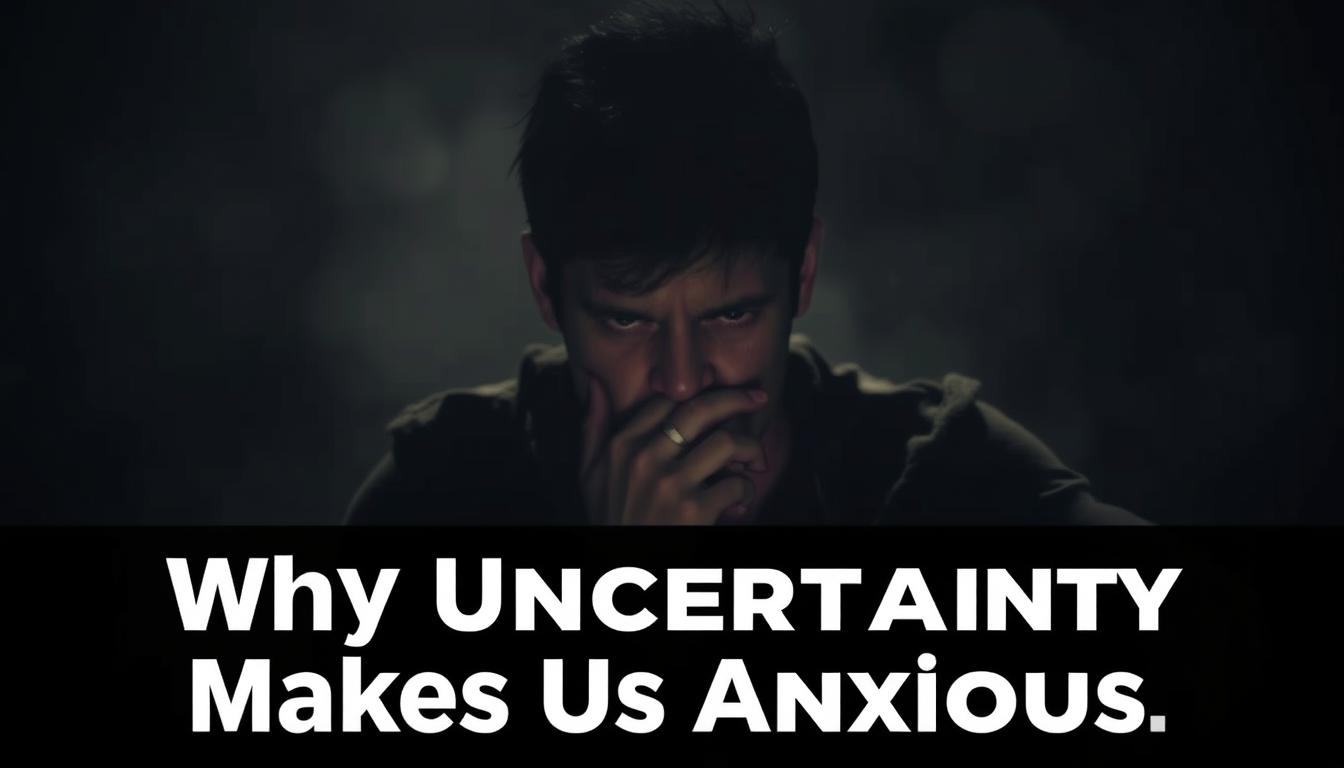
When we face uncertainty, anxiety grows. Our brain sees the unknown as a threat, causing fear and discomfort. This is a survival mechanism.
Studies at the University of California, Davis found people feel more anxious with unpredictable dangers. In tests, people stayed longer in virtual worlds for cash when shocks were predictable. But when the timing of threats was unclear, stress hormones like cortisol went up.
This mirrors rodent studies where uncertainty caused anxiety. The brain’s response to uncertainty is not random. It’s a way to keep us alert.
Why does this matter? Knowing why uncertainty makes us anxious helps us understand its impact. From missing a reply to health worries, our brain signals danger. But science offers hope: mindfulness and routines can reduce these signals, easing our discomfort.
This article will explore how ancient survival instincts meet modern life. And how we can adapt to this.
Understanding Anxiety and Uncertainty
The uncertainty definition is about not knowing what will happen next. This lack of predictability can make us feel anxious. Think about making a choice without knowing the outcome—your heart might race or you feel uneasy. That’s what happens when we face psychological uncertainty.
“In a typical experiment, participants are hooked up to electrodes capable of delivering a harmless, but slightly painful, electric shock… unpredictability significantly increases discomfort.”

People often see ambiguity intolerance as a sign of danger. For instance, a tiny chance of a plane crash seems huge because our minds make the unknown seem worse. This mix-up between what’s real and what we think makes us worry more. Some try to control their fears by doing the same things over and over again. But this only makes things worse.
Every day, we make choices that involve uncertainty. Our brains, which like to be in control, get stressed when we’re unsure. The Intolerance of Uncertainty Scale shows how much someone fears “what if?” situations. People with high scores often have anxiety disorders, where their brain overreacts to unclear signals.
Getting to know these patterns is the first step. Seeing anxiety as a natural response to threats, not a flaw, can help. Taking small steps, like pausing before reacting to uncertainty, can change how we see life’s unpredictability.
The Science Behind Uncertainty and Anxiety
Our brain’s uncertainty response begins with the science of anxiety. When we face unclear situations, the amygdala kicks in. This makes us extra alert, ready to face threats, even if none are there.
The anterior insula then checks for risks. Sometimes, it sees dangers that aren’t really there. This can make us feel more anxious than we should.

Uncertainty takes a toll on our minds. Making choices when we’re unsure uses up our mental energy. This leaves us with less brainpower for other things.
As we try to make decisions, our focus starts to fade. Research shows this is similar to how mice act in open spaces. They avoid these areas because their brains are wired to fear the unknown.
Mice studies reveal anxiety neurons in the ventral hippocampus fire during exposure to open spaces, driving avoidance. This parallels human reactions to uncertainty, showing how brain pathways shape fear-driven actions.
O’Donovan’s research shows PTSD patients have a stronger amygdala response to threats. This makes their anxiety worse. The brain’s stress systems can get overwhelmed by constant uncertainty, leading to health problems.
Learning about how our brains handle uncertainty is key. By understanding anxiety, we can tackle the root causes of stress. This is the first step to managing it.
Evolutionary Perspective on Uncertainty
Human anxiety has deep roots in our past. Our ancestors had survival mechanisms to stay alive. When they faced unknown dangers, like rustling bushes or strangers, their brains focused on threat detection.
Reacting fast to threats, even when unsure, helped them survive. This quick response was key to staying alive.

“Treating unknowns as threats was adaptive, as long as it didn’t hinder finding food or shelter.”
Today, our brains see uncertainty as a threat. The systems that once spotted predators now react to safe situations. A job interview or financial worries can trigger the same fear as ancient dangers.
While this anxiety kept our ancestors safe, today’s stressors don’t require fleeing or fighting. These survival mechanisms were once vital but now can be too sensitive.
Understanding this helps see anxiety as a leftover from our past, not a flaw. Recognizing how our evolution shapes our reactions can help us face today’s challenges with kindness towards ourselves.
The Effects of Uncertainty on Decision-Making
When we face uncertainty, our brains tend to make choices that aren’t always the best. A study by Dr. Tanovic found that only 37% of people chose to wait for better rewards in a game. This shows how we often prefer to avoid uncertainty, even if it means missing out on better options.

Our fear of uncertainty leads us to make certain choices. Studies show that anxious people see threats as 50% more real when information is unclear. For example, hearing about a tragic event can make us think similar dangers are more likely by 74%. This fear can make us choose safety over rewards, even if it costs us.
Brain scans show that anxious people’s brains react differently. The amygdala, which deals with fear, gets too active, while areas for logic don’t work as well. This imbalance means anxious people often choose safer options, even if they’re not the best. But this caution can also hold us back from trying new things.
Knowing how our brains react to uncertainty is the first step to making better choices. Seeing uncertainty bias as a natural response can help us make more informed decisions. By understanding how our minds work, we can make choices that are clearer and more beneficial for us.
Coping Mechanisms for Managing Anxiety
Managing anxiety starts with organizing your worries. The Uncertainty Matrix (or Rumsfeld Matrix) helps sort unknowns. It shows what you can control and what you can’t, guiding you to practical anxiety coping strategies.
Cognitive Behavioral Therapy (CBT) changes how you think. For example, questioning if your fears are realistic can reduce fear. This builds uncertainty tolerance and helps you see things differently.
Metacognition techniques let you observe your thoughts. Noticing when you’re catastrophizing helps. This creates space and eases anxiety. Journaling or talking to a friend can also help.
Mindfulness and exercise lower stress. Good sleep and diet, like omega-3 foods, also help. The pandemic made anxiety worse, but these strategies can help you cope.
Improving uncertainty tolerance takes time and practice. Try tools like the Matrix or CBT exercises. Recognizing when thoughts spiral is a good start. Remember, it’s about progress, not perfection.
Social Influences on Anxiety Related to Uncertainty
Social interactions shape how we handle social uncertainty. Cultural norms tell us what’s okay when we’re unsure. For example, 16% of Chinese college students say they’re very anxious, a number that’s gone up by 0.27 standard deviations from 1998 (Xu, 2010; Shi & Xin, 2018). This shows how societies that value group harmony might make us more worried about what others think when things are uncertain.
Think about texting a partner for updates a lot. This way of dealing with uncertainty changes a lot between cultures.
But, having a supportive community can help. Families or teams that talk openly about their worries can feel less stressed. Yet, if groups start to focus too much on the worst that could happen, things can get worse. For example, a team under pressure might get more anxious if everyone keeps talking about the worst-case scenario.
Studies show that how we talk about uncertainty can affect our anxiety levels by 4% (Boelen & Dugas, 2002). This shows how important our communication style is.
Managing social uncertainty well means being empathetic. Talking openly about our fears, like asking “What’s the worst/best/best case?” can change how we see uncertainty. Knowing others feel the same way can also help us feel less alone. Building systems where communities share solutions can help us all deal with anxiety better.
The Role of Information in Reducing Anxiety
When things are unclear, we seek information. Information seeking behavior helps us find answers. Psychologist Ema Tanovic says, “Uncertainty makes situations feel more threatening.”
“When we worry, we think about possible outcomes to prepare—but worrying doesn’t reduce uncertainty. It traps us in a loop of anxiety.”
A 2020 study followed 1,065 people during the pandemic. It showed that more anxiety led to more knowledge gathering. But too much searching can cause information overload, making stress worse. For instance, constant health news checks can overwhelm and cause panic.
It’s important to find a balance. Looking at trusted sources once a day can help clarify risks. Setting limits on media time helps avoid feeling overwhelmed. The aim is to understand, not to have all the answers.
Building Resilience in the Face of Uncertainty
Building uncertainty resilience starts with small steps. Practices like mindfulness and journaling help you see the unknown differently. They train your brain to handle uncertainty better, making you more responsive than reactive.
“People who score high in intolerance of uncertainty often struggle to unlearn fears. Yet, gentle exposure to manageable risks can shift this pattern,” says research by Carleton. Small experiments—like trying a new route to work or tackling a minor uncertainty—strengthen mental flexibility.
Emotional regulation is key. When uncertainty makes you stressed, take a pause. Breathe deeply and acknowledge your feelings without judgment. This simple act can calm you down and clear your mind.
Studies show mindfulness practices can reduce anxiety by 25% in many cases. Having daily routines, like checking in or keeping a gratitude list, helps you stay grounded during tough times.
Resilience isn’t about avoiding discomfort but learning to navigate through it. Think about times when you successfully handled uncertainty. This builds your confidence in adapting to new situations.
Over time, these strategies turn uncertainty into a learning opportunity. Progress may not always be straight, but each step forward makes you stronger. It helps you embrace life’s unpredictability more easily.
Future Directions: Navigating Uncertainty
Uncertainty isn’t just a barrier—it’s a catalyst. Think of a weather forecast with an 80% chance of rain. It shows there’s a risk, but also a chance to prepare and adapt. This positive uncertainty can spark creativity, driving people and companies to innovate.
Companies like Google and 3M show that adaptability skills can turn uncertainty into opportunity. They encourage trying new things, proving that uncertainty can lead to growth.
Seeing uncertainty as a chance to grow is key. People with a growth mindset view it as a chance to learn. Research shows that those who are more open to change can handle uncertainty better.
Healthcare systems during crises used real-time data and teamwork to manage uncertainty advantages. They balanced urgency with ethical values, showing how to navigate uncertainty.
Building resilience starts with small steps. Mindfulness and looking back at times when uncertainty led to success can boost confidence. Tools like the Intolerance of Uncertainty Scale (IUS) help measure and manage anxiety.
But the real solution is in taking action. Open communication, self-care, and valuing curiosity over control help us see challenges as part of life’s flow.
As we face the unknown, remember: the human spirit thrives in the space between fear and possibility. By nurturing adaptability and curiosity, we turn uncertainty into a path for innovation, connection, and resilience. The future isn’t predictable—but it’s ours to shape.